
Mensija, San Ġwann
The Returning Image of Mensija
Il-Leġġenda tal-Mensija
Children’s reading · Ages 7+
The Picture That Kept Going Home
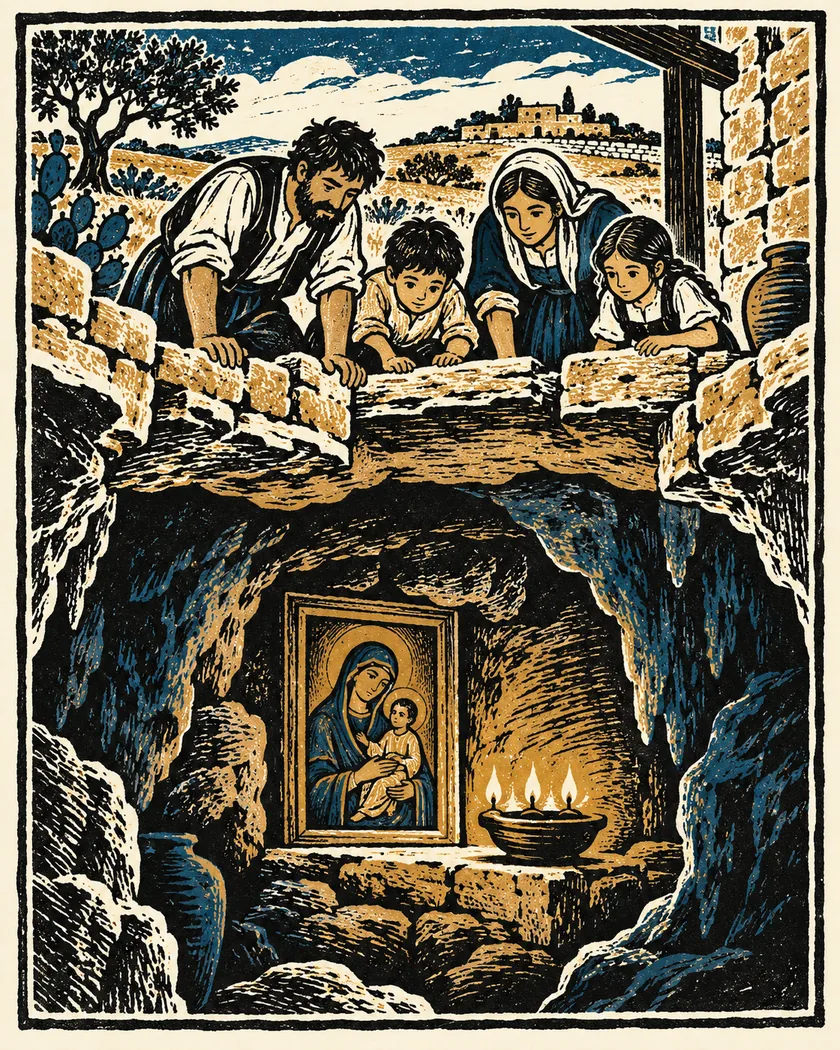
Indri was coming into his farmhouse when he noticed something strange. A thin line of light shone through a crack in the stone.
“Come and look!” he called to his family.
They carefully cleared the ground around it. Below was a cave. Inside, an oil lamp with three wicks was shining beside a sacred picture.
Indri took the picture to the parish priest. But in the morning, the story says, it was back in the cave!
They moved it again. Back it came.
Even when it was taken to the bishop, the picture returned to its old place.
“Perhaps this is where it belongs,” the people decided.
They cleaned the cave and made it a place for prayer.
The legend is remembered at Mensija in San Ġwann. Its name means “forgotten”. The picture’s mysterious journeys are part of the story, rather than something we can prove. But the place was no longer forgotten. People had noticed a small light, looked more closely and found a reason to care for it.
Adults’ reading
The Light beneath the House
The farmer expects darkness beneath his house. Instead, a narrow crack gives out light.
In one version of the Mensija legend, Indri calls his family and begins clearing the ground. The opening reveals a cave, a sacred image and an oil lamp with three burning wicks. There is no person there to explain who has tended it.
He carries the picture to the parish priest. By the next morning, it is back underground. Another removal produces another return. The bishop’s intervention does not settle the matter: the image returns once more.
At last, the response changes. The people stop moving the image and begin caring for the place. The cave is cleaned and an altar established.
The tale is a devotional explanation of belonging. A picture that cannot speak appears to insist on its own address. Those responsible for it come to understand that preservation may require attention to the setting, not simply possession of the object.
Mensija means forgotten. The name gives the story an additional rhythm: discovery, removal, return and remembrance.
Different accounts place the farmer at his farmhouse or working in a field. The discovery is traditionally set in the fifteenth century, while a cave church is documented later. Nor is it certain that the triptych seen today is the exact image imagined by the legend.
Those distinctions matter, but they leave the story’s central image intact. Beneath an everyday surface, something has been overlooked. A line of light interrupts a routine evening, and a community gradually learns how to respond.