
Wied il-Għasel, Mosta
The Hermit and the Floating Cloak
L-Eremita ta’ Wied il-Għasel
Children’s reading · Ages 8+
The Cloak That Became a Boat
A hermit is someone who lives a quiet life, often alone. In this old Mosta story, a hermit lived in a cave at Wied il-Għasel.
He asked the people nearby to treat others better. They grew angry and shouted at him to go away.
The hermit left the cave. The people followed him until he reached the shore. Ahead was the sea. He had no boat.
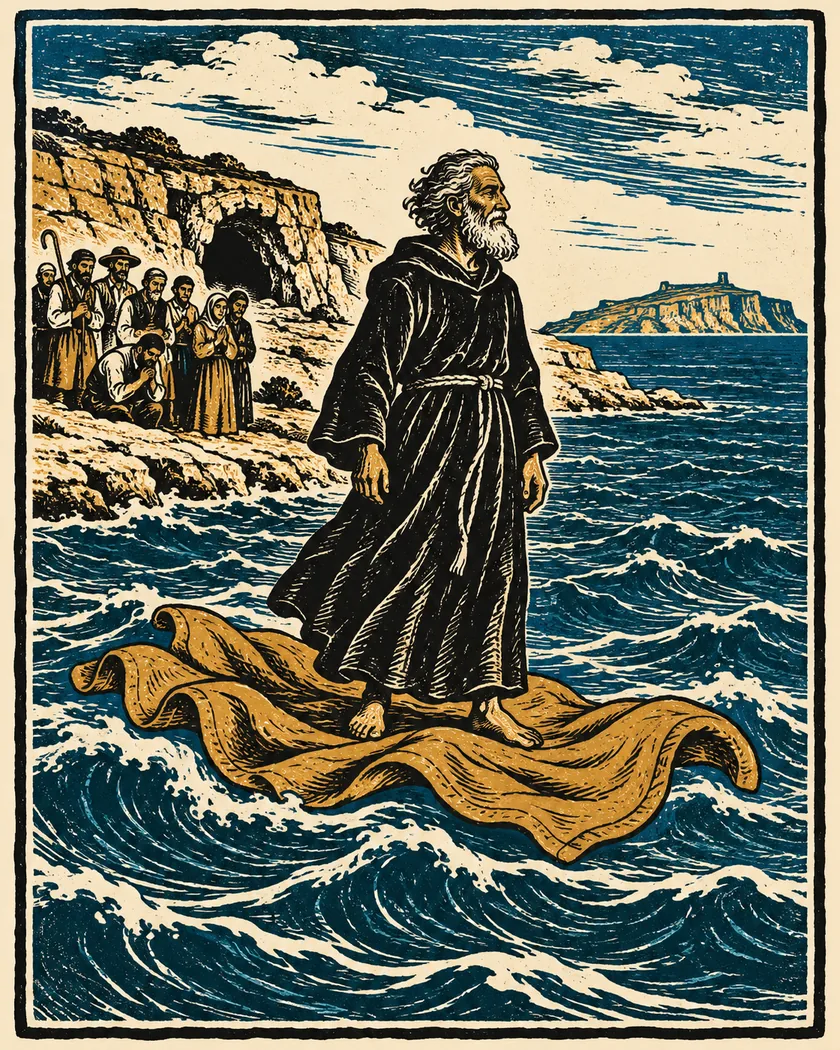
Then, in the legend, he took off his cloak and laid it on the water.
He stepped onto it—and it floated like a little boat!
The cloak carried him away to Gozo. On the shore, the people stared. Their shouting stopped.
They began to think about how they had treated him. Later, the story says, they built a chapel in the cave he had left.
Some versions give him the name Korradu; others change his destination. A real cloak cannot carry you safely across the sea. But in the story it makes a wonderful picture: someone who seemed trapped finds a way forward, and those left behind learn to be kinder.
Adults’ reading
What the Shore Witnessed
The people follow the hermit because they want him gone. At the shore, they finally discover what gone may mean.
He has lived in a cave at Wied il-Għasel, speaking against the conduct of those around him. In one version, the shepherds resent his admonitions and drive him away with stones. Their pursuit ends where the land ends.
The hermit removes his cloak and spreads it on the water. He steps onto it. The sea carries him beyond them.
On land, hostility gives way to astonishment, then repentance. The story says a chapel is built at the cave he has left.
The cloak is the tale’s unforgettable object. Something meant to shelter a body becomes a means of escape. No fleet is summoned; no pursuer is struck down. The miracle removes the person they have mistreated and leaves them with the meaning of their actions.
Local tellings attach names such as Corrado or Korradu to the hermit, sometimes connecting him with Conrad of Noto. The destination also varies: Gozo in one tradition, Sicily in another. This version follows the Gozo crossing, without treating it as a documented voyage.
The chapel’s dedication introduces another distinction. St Paul the Hermit is Paul of Thebes, not Paul the Apostle, and neither name automatically identifies the traveller in this tale.
A visitor can enjoy the cave’s setting without collapsing those different lives into one. The legend belongs to the place through its image of departure: the shoreline holds the crowd, while a piece of cloth takes the unwanted man away.
Sources and further reading
- Mosta Dome visitor guide — Chapel St Paul the Hermit
- Kappelli — Chapel of St Paul the Hermit
- Christian Attard University of Malta repository — Wied l Eremiti Storja Antika 2009
- Mario Buhagiar University of Malta repository — The Church of St Paul the Hermit
- Mosta Rotunda Foundation — St Paul the Hermit