
Wied l-Isperanza, Mosta
The Girl and the Spider of Speranza
Ix-Xebba ta’ Wied l-Isperanza
Children’s reading · Ages 7+
A Very Small Helper
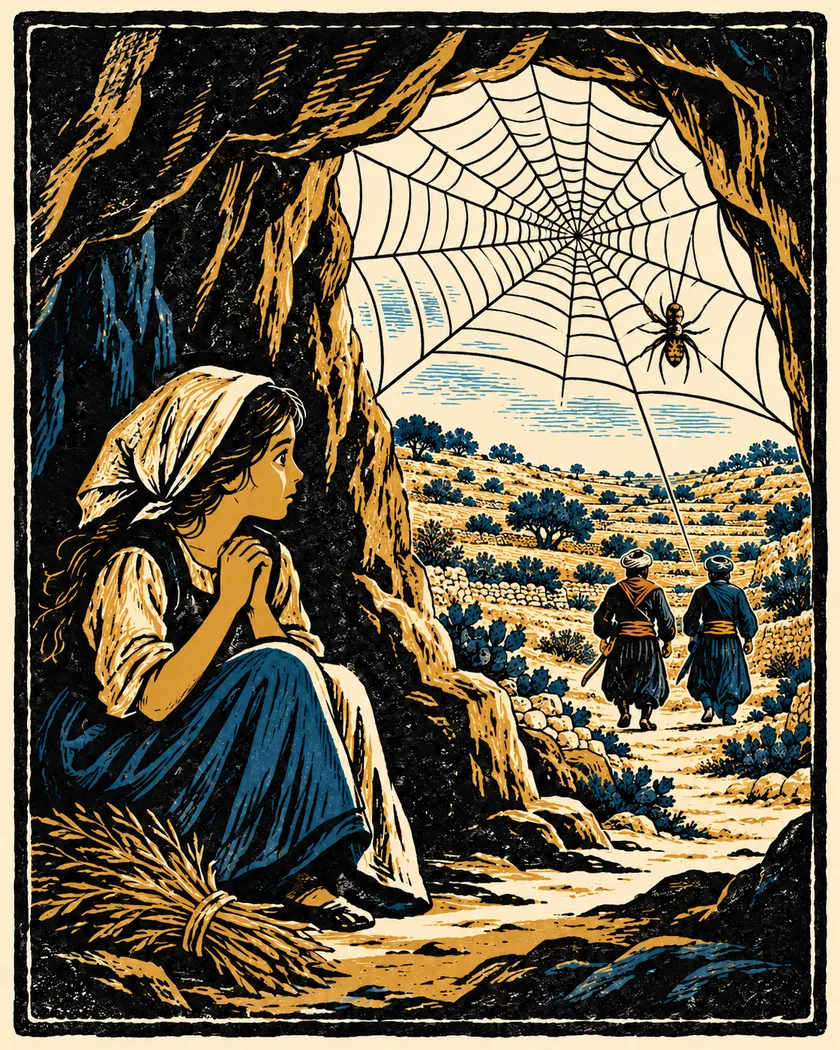
The girl heard voices before she saw the men.
She had been gathering grass near Mosta. Now two strangers were coming towards her, and she knew she needed somewhere safe to hide.
A cave opened in the rock. She slipped inside and stayed very still.
“Please help me,” she prayed to Our Lady.
Near the entrance, a spider began to move. From one side to the other it stretched a thread. Then another. Then another.
The girl watched the web grow across the opening. Such a small creature! Such careful work!
Footsteps stopped outside.
“Look at that web,” one of the men said. “Nobody has come through here.”
The footsteps went away.
The girl waited until all was quiet. Then she stepped into the daylight, safe at last.
The story is remembered beside the Chapel of Our Lady of Hope, at Wied l-Isperanza. We do not know whether it happened exactly this way. But people have kept telling it: a story in which a frightened girl finds hope, and a very small helper makes a very big difference.
Adults’ reading
The Thread across the Door
At first, the cave seemed a poor hiding place. It had an entrance anyone could see.
The girl had been gathering grass in the countryside near Mosta when the corsairs appeared. She reached the opening before them and withdrew into its shade. Outside, the light remained ordinary. Inside, she measured the silence against the sound of approaching steps.
She prayed to Our Lady. She could do little else.
Then a spider began crossing the entrance. Its thread caught the light, disappeared, and caught it again. The girl watched an almost weightless barrier form between herself and the people who might take her away.
When the pursuers arrived, they read the web as evidence. An intact web meant an undisturbed entrance. They moved on.
For the girl, the same threads meant something entirely different.
The legend gives the rescue a religious meaning, and the chapel at Wied l-Isperanza preserves the association with hope. Its later construction is not a date for the girl’s escape. Nor do the surviving accounts give us one fixed portrait of her: she gathers grass in one version and tends sheep with her sisters in another.
That change does little to weaken the central image. A person whose safety appears to depend on speed and strength survives through something fragile.
The cave does not close. No great door swings across it. A spider continues its work, and the pursuers mistake what they see.
It is a quiet ending for a story about danger. Perhaps that quietness is what makes it linger: after the footsteps fade, a few threads are still moving in the air.