
Mosta
The Bride of Mosta
L-Għarusa tal-Mosta
Children’s reading · All ages
A Journey to Bring Marianna Home
Marianna was getting ready for her wedding in Mosta. She and Toni were looking forward to their life together.
Then corsairs arrived, and Marianna was taken far away across the sea. Toni was frightened for her, but he did not give up.
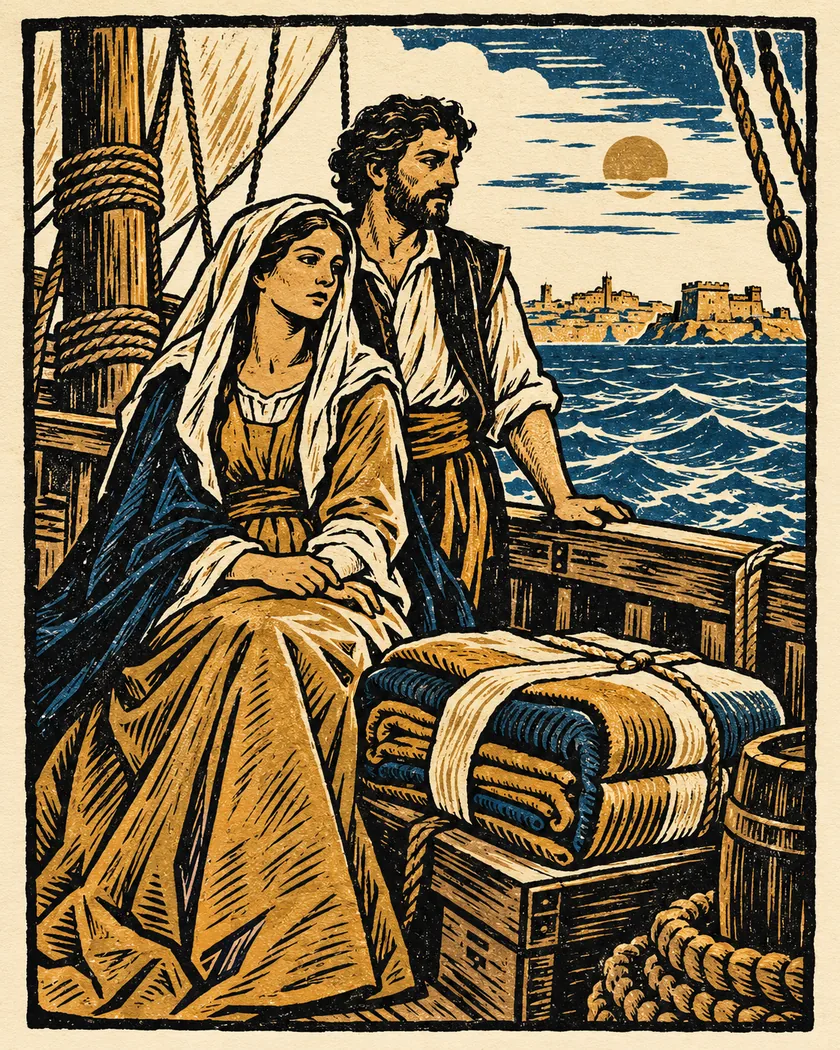
He learned that she had been taken to Tripoli. To travel there without attracting attention, he dressed as a merchant selling wool.
He carried cloth, asked careful questions and kept searching.
“Somewhere in this city,” he thought, “there may be a way to help her.”
At last, he found Marianna and managed to bring her away from captivity. Together they began the journey back to Malta.
For this gentler telling, we leave them returning home, where Marianna can rest among people who care for her.
The old legend has several versions, and some have a sad ending. This version keeps the rescue at its heart. It reminds us that being brave does not mean never feeling afraid. Sometimes it means taking the next careful step to help someone.
Adults’ reading
The Return to Mosta
The wedding preparations belong to a future that the raid abruptly removes.
In the Mosta council’s version of the legend, Marianna Cumbo is preparing to marry Toni Manduca when corsairs take her away. The sea that brings traders and visitors becomes a distance across which a family cannot easily reach.
Toni learns she is in Tripoli. He goes there disguised as a wool merchant. The disguise is a modest thing beside the danger: cloth and a plausible reason to travel, rather than a hero arriving with an army.
The tale gives his persistence a reward. He finds Marianna and brings her back to Malta.
Then the version turns. She dies soon after her return, overcome by what she has endured. The rescue succeeds, but the life imagined before the raid cannot simply be resumed.
That ending deserves space. It resists the familiar theatrical impulse to finish on a triumphant embrace. Homecoming can be precious without undoing harm.
The story is commonly linked to the raid of 1526, but its literary and oral history is more complicated than a single dated incident. Ġużè Cassar Pullicino’s comparative study documents variants and affinities with a Sicilian bride-captivity tradition. Names, helpers, ransom episodes and conclusions move between tellings.
For a family audience, a performer may choose a gentler adaptation and end at the return. For adults, the tragic version carries a different force.
At its centre is a woman whose life should not be reduced to a prize recovered by a brave man. Her suffering is what makes the familiar promise of rescue incomplete.