
Qrendi and Filfla
Il-Maqluba and the Missing Village
Il-Maqluba
Children’s reading · Ages 8+
The Place That Turned Over
Near Qrendi is a great hollow in the land. Its name is Il-Maqluba, which means “overturned”. Trees grow inside it, and an old story tries to explain how it came to be.
In the story, a little village once stood there. A kind woman asked the people to change their unkind ways, but they would not listen.
Then a terrible storm came. The woman prayed in a small chapel, and the ground beneath the village gave way.
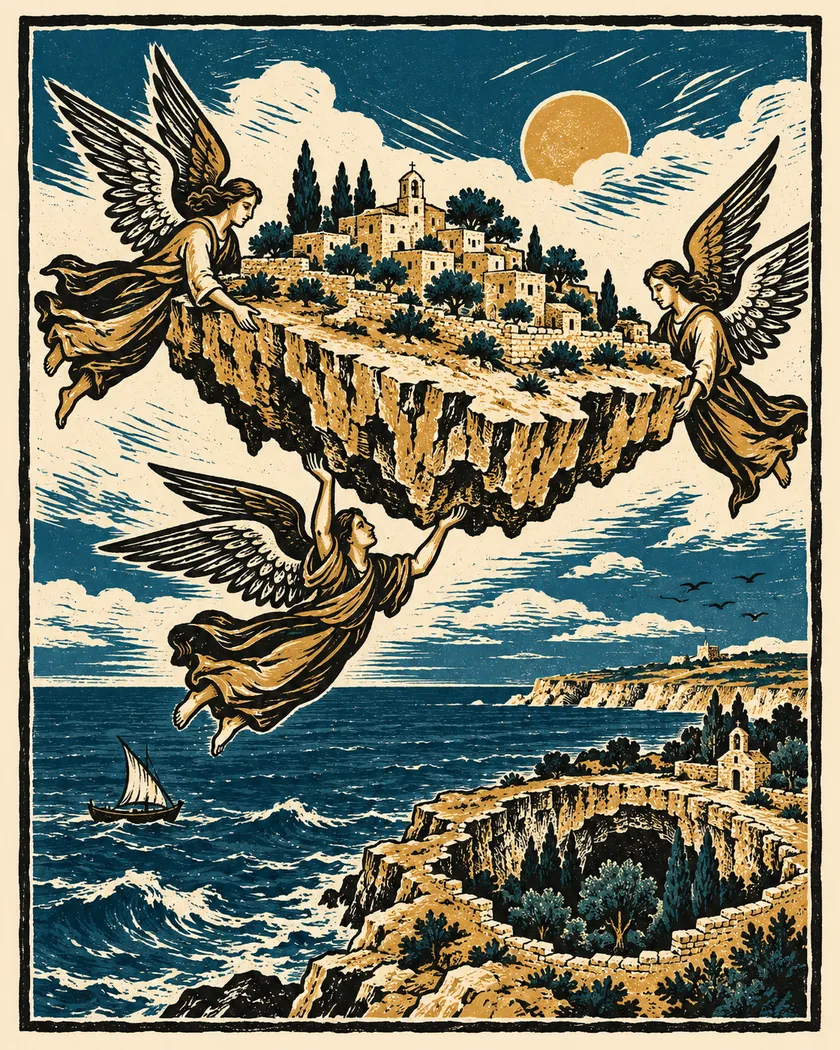
One version adds an amazing twist: angels lifted the fallen land and carried it out over the sea. There it became the little island of Filfla.
Imagine a whole piece of countryside travelling through the sky!
That is the storybook explanation. In the real landscape, Il-Maqluba is a sinkhole: a place where rock has collapsed. Filfla was not carried there by a flying village.
Old stories helped people talk about surprising places. Today, we can enjoy their imagination and also ask how nature made the land we see.
Adults’ reading
A Village Removed from the Map
The landscape supplies the question before the storyteller supplies the answer. Near Qrendi, the ground opens into a deep, wooded hollow. Why is there an absence where there might have been a village?
The legend fills that absence with people who would not heed a warning. A pious woman asks them to abandon their harmful ways. They dismiss her. A storm arrives, the ground collapses, and the village disappears. In one account, the woman survives while praying in the chapel at the edge.
Another part of the tradition sends angels to remove the fallen land. They carry it over the sea and cast it down as Filfla. A hollow inland and a small island offshore become two halves of one explanation.
The tale is dramatic, but its moral is severe. It imagines catastrophe as judgement. A modern listener need not accept that reading of disaster to understand why an earlier community might have used it: fear, warning and religious belief all find a visible place in the landscape.
Il-Maqluba is a geological feature formed by collapse in limestone. That physical explanation is different from the village’s punishment or the island’s miraculous journey. Even the traditional storm date varies by a day between accounts.
What remains compelling is the story’s way of connecting what can be seen. The hollow is not simply empty; it is the memory of something taken away. The island is not simply distant; it is something moved.
Stand at a permitted viewpoint and the contrast is striking. The legend remembers destruction. The living hollow is full of trees.